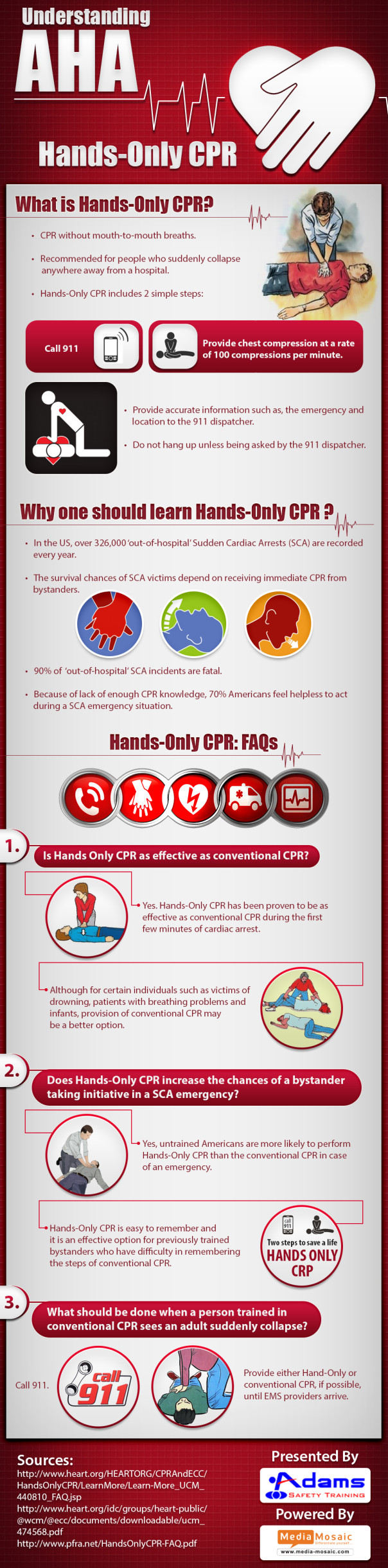
Did you know around 90% of ‘out-of-hospital’ Sudden Cardiac Arrest (SCA) incidents are fatal? The absence of immediate first-aid is one of the major reasons that cause the death of SCA victims. Due to lack of CPR knowledge, many people fail to provide immediate medical help to the patient.
Approved from American Heart Association providing hands-only CPR is an effective way to save the life of a person who has suffered a sudden cardiac arrest. In hands-only CPR, chest compressions are performed on the patient without mouth-to-mouth breathing. Studies have shown that hand-only CPR can be as effective as conventional CPR. Providing hands-only CPR immediately to the patient can save his life. Apart from giving chest compressions, it is important to call emergency medical care so the medical help arrives on time. Take a look at the below infographic for more information on AHA hands-free CPR and how it can save the life of a patient.
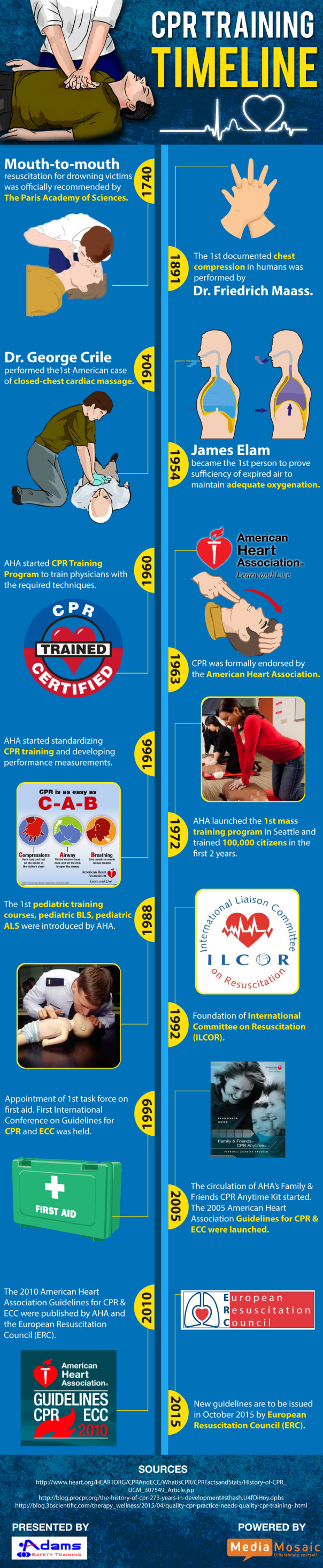
Sudden cardiac arrest causes about 325,000 deaths in the United States each year and at least one child dies from choking on food every five days in the country. The number of deaths due to cardiac arrest, choking, and drowning can be decreased with immediate CPR treatment. CPR is a lifesaver emergency treatment given to victims to restore the flow of oxygenated blood to the brain. However, CPR may seem to be a modern technique but its use can be traced back almost 275 years from now (2015). The infographic presents a timeline of the development of Cardiopulmonary Resuscitation (CPR) and highlights the history of CPR.
The CPR originated in the year 1740 when the Paris Academy of Sciences officially recommended mouth-to-mouth resuscitation for drowning victims, but the first documented chest compression was performed by Dr. Friedrich Maass. When given properly and immediately to a victim, who has stopped breathing, CPR can save lives. If you don’t know how to perform CPR correctly, then join CPR training classes, and see the below infographic to learn more about CPR history.
CPR or cardiopulmonary resuscitation is a live-saving procedure performed during emergencies. The technique is especially designed to keep the blood circulation flowing when a victim is in cardiac arrest. CPR is an effective procedure that can be implemented until professional medical assistance is available.
CPR procedure consists of two components including chest compressions and breathing. The procedure usually starts with 30 compressions followed by 2 breaths of air. CPR can be given to any victim (infant, adult, elderly, pregnant or other) who encounters an emergency situation.
What is CPR for a pregnant victim?
CPR procedure for a pregnant victim is same as CPR for an adult victim. It requires rescue breaths and chest compressions, which help to circulate blood throughout the mother and her baby. However, CPR for a pregnant woman should be performed carefully since in such cases the life of the fetus is also at risk.
Why a different CPR technique is adopted for a pregnant victim?
In pregnant victims, the enlarged womb makes it challenging to perform the normal chest compressions. Therefore, two people with good CPR training are required to carry out the rescue procedure, with one of the rescuer assisting to shift the uterus to the left in order to alleviate the pressure accumulated on the thoracic side.
CPR Steps to Perform on a Pregnant Victim
What are the CPR steps to perform on a pregnant victim?
• Like with any casualty of cardiac arrest, it is advisable to immediately call the emergency number ensuring that medical assistance approaches as quick as possible.
• When you make an emergency call, it is better to inform the hospital that the casualty is pregnant.
• Prior to performing chest compressions, it is wise to manually move the uterus to the left. While doing this, place the victim in a comfortable position- usually lying on a flat surface.
• Start with the compressions, without alternating the procedure with rescue breathing.
• Try to perform only hands compressions to ensure that the major veins have enough blood flow.
• Continue to make 30 compressions followed by two breaths until exhaustion.
Warnings
In order to perform these skills on a pregnant victim, getting certified in CPR course is advisable alleviating the risk of responsibility. Be confident while performing CPR and remember, your little effort can save two lives at once.
Cardiopulmonary Resuscitation (CPR) is a lifesaving procedure that is useful in many emergencies, including heart attack or choking. As a first responder, you can buy time for the injured person before medical professionals arrive. This video throws light on the reasons to take a CPR Certification Class in San Jose.
Every year, more than 325,000 people die from a sudden cardiac arrest while at home, office or public place. This number is staggering. In emergency situations, every second counts. By knowing how to perform CPR could help you save someone’s life. The chances of survival rate for the victim increases if CPR is performed on time. That’s why it’s so important for EVERYONE to learn CPR. People, who are CPR certified, feel much more empowered and confident and are able to apply it in case of emergency. Another advantage of CPR certification is that you learn to operate automated electronic defibrillator (AED). You can get an edge over others while applying for jobs such as babysitter, lifeguard or personal trainers. So, it’s recommended to take CPR class from reputed organization such as American Heart Association (AHA).
If you’re planning to get your CPR certification, you have a lot of options such as Healthcare Provider, Heart saver and Non-Healthcare Providers among others. How do you know which one to choose? Choosing the right CPR certification class can be very confusing! It starts with understanding why you are taking the class and then selecting the one that suits your employment or personal needs. Here are some questions you should ask yourself to ensure that you sign up for the right CPR certification class:
• Which CPR certification do I need?
• Does my CPR certification need to focus on infants, children, adults or pets?
• Should I choose the CPR certification of the American Heart Association or American Red Cross?
• Do I need to learn how to operate AED as well?
CPR certification for Healthcare Providers
AHA Basic Life Support for Healthcare Providers is an advanced CPR class for anyone involved in healthcare industry or licensed as a medical provider such as paramedics, nurses, pharmacists, respiratory therapists, dentists, medical assistant, hospital technician and others. All American Heart Association CPR classes include AED training.
CPR certification for Non-Healthcare Providers
Heart saver CPR and AED classes are geared towards people working outside the health industry. These classes are ideal for people, who want to learn how to perform CPR, foster parents, or anyone working in a company that requires CPR training.
Wondering which CPR Class is right for me? No worries, whatever is motivating you to take a CPR class, there is an option for you. However, the most important thing is that you choose the right CPR class and learn to save a life in emergency situations.
Cardiopulmonary Resuscitation (CPR) is an extremely useful skill that can help you save someone’s life. Americans understand the importance of learning CPR skills in saving the life of a family member or friend in an emergency. That’s why they try to get their CPR certification from reputed organization. If you’re an employee or work in a health care center in California, then you must have CPR training. Here are few tips on how to choose a CPR company in California, especially in San Francisco Bay Area:
Go with the expert
Not all CPR courses are created equal. So, go with the expert in CPR training. Longevity is an important factor when choosing a CPR company. Select a recognized CPR company, which is providing CPR courses for long time in the Bay Area.
Check the EMSA license
CPR or first aid trainings are required to be compliant with state law. Such trainings have to be provided only by an EMSA approved provider. So, check for CPR training providers, who are certified in EMSA and allowed to teach CPR courses. You can also check for the rating provided to them by the local chamber of commerce.
Check the CPR certification courses offered by them
The American Heart Association (AHA)’s CPR certification is said to be more widely known and accepted. This will help you choose the CPR company that provides AHA’s CPR certification program in San Francisco Area.
If all the above mentioned criteria are fulfilled when you’re searching for a CPR company in San Francisco Area, then you’ve found the right CPR training provider for you. After all, quality training is important when it comes to a matter of life and death!
CPR is an essential lifesaving technique, and perhaps, you know the correct procedure of administering CPR on a victim. But, do you know where did it come from? How did CPR evolved? Modern CPR developed in the late 1950s or early 1960s. Let’s have a look into the history of CPR.
CPR timeline
• 1960s-1970s
1. Although, the Paris Academy of Sciences had recommended mouth-to-mouth resuscitation for drowning victims in late 1700s, but Dr. James Elam and Dr. Peter Safar are considered as the main discoverers of mouth-to-mouth ventilation.
2. Later, Dr. Peter Safar wrote a book called “ABC of Resuscitation, but the CPR technique didn’t begin until 1960s when people began to realize the importance of performing CPR in life-threatening situations. The American Heart Association (AHA) became the forerunner of CPR training programs for the general public.
• 1990s
1. Some health organizations started the Early Public Access Defibrillation (PAD) programs, so that people can provide successful resuscitation to sudden cardiac arrest victims.
• 2000s
1. AHA and International Committee on Resuscitation (ILCOR) recommended the public to use AEDs on children.
2. In 2005, AHA released a CPR kit that contained all information on how to use AED, perform CPR and save a victim during choking.
3. In 2008, the AHA released Hands-Only CPR technique.
4. In 2010, AHA modified the A-B-C procedure into C-A-B in order to increase survival rate for cardiac arrest victims.
5. In 2015 around Oct the new guidelines are expected.
CPR has saved millions of lives over the past decades. It will certainly save millions more in coming years if people attend CPR certification programs and learn lifesaving skills.
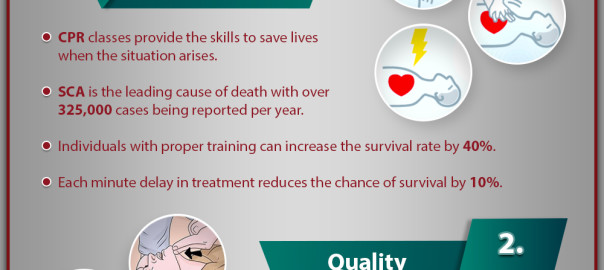
This Infographic focuses on the importance of CPR and benefits of having CPR Certification. It also highlights the advantages of knowing CPR and how to operate AED.
Cardio-pulmonary resuscitation (CPR) is an important skill that everyone should learn because you never know when you may need this skill to save someone’s life. People, who are CPR certified, feel much more confident and empowered that they can spring into action in case of emergency. By taking quality training in CPR in San Francisco Area, you will not only know how to administer CPR but also you will be able to confidently direct others as to what to do and whom to call. CPR Certification is mandatory in medical profession and in some organizations. But, if non-medical professionals and citizens also learn about how to perform CPR, then they will be able to save more and more lives during difficult situations. So, take the time to get CPR certified and help someone when they need it most.
Cardiopulmonary resuscitation (CPR) procedure has changed noticeably in the past decade, and it appears to have moved towards simplification. Survival of victims depends on the quality of the CPR. For this reason, American Heart Association (AHA) has time and again changed the process of administering CPR on patients by bystanders or certified people. Let’s have a look on the CPR steps that you can follow in case of emergency in 2015.
A – B – C (Airway – Breathing – Compressions) process becomes C – A – B
You no longer need to look or feel for breathing in unresponsive victims. Start the chest compressions before giving rescue breaths. That’s why the sequence A-B-C has been changed to C-A-B, so that chest compressions can be initiated sooner and blood flow can be maintained to avoid brain damage.
30:2 compression-ventilation ratio
After giving 30 compressions, a rescuer should give a total of two breaths to the patient. Also, remember that chest compressions should be delivered at a rate of at least 100/minute and each compression need to be at least 2” deep.
Minimize interruptions in compressions
Interruptions should be minimized during chest compressions in order to maximize the number of compressions per minute and increase survival chance for the victim.
Use AED as soon as it is available
In adult use the AED as soon as it is available With Infant and Children in the event that the victim is not showing any movement following five cycles of CPR, then use automated electronic defibrillator (AED) on him/her to restore circulation.
By following these techniques, you may be able to save the life of a victim. In fact, you, your friends and family members should attend CPR classes to develop skills and knowledge required to face such emergency situations.
Are you CPR certified? If not, then think about it again! Perhaps, you know that cardiopulmonary resuscitation (CPR) is a lifesaving procedure that is performed on someone, who’s not able to breathe or his/her heartbeat has stopped. However, do you know that 92% of cardiac arrest victims fail to survive, even after receiving CPR? As a bystander, you can increase the survival chance of such victims by performing CPR in a timely and right manner. That’s why everyone should enroll in CPR training program. There are numerous benefits of CPR certification and these are:
You get quality training
For sure, you can get basic understanding about CPR and how it works on the Internet, but nothing is more imperative than receiving quality training from reputable organizations such as the American Heart Association (AHA). Hand-on training received during CPR classes can make a huge difference during emergency situation.
You can increase your self-confidence
People, who undergo CPR training, achieve a certain level of self confidence, and this helps them to save others life, whether at home or office. Your fast and quick response during critical situation can make a significant difference between life and death of the victim.
You learn to operate AED
During CPR training, you learn to operate artificial electronic defibrillators (AED), which is used to restore the heart’s electrical signal in victims of cardiac arrest.
By getting certified in CPR, you stand out as someone, who has a true sense of responsibility. Moreover, your ability to save someone’s life is more than just satisfying!
So, what makes you wait for? Join Adams Safety as it is the best training institute providing CPR Certification in San Francisco Bay Area. Learn and get certified now.