Category Archives: CPR Certification

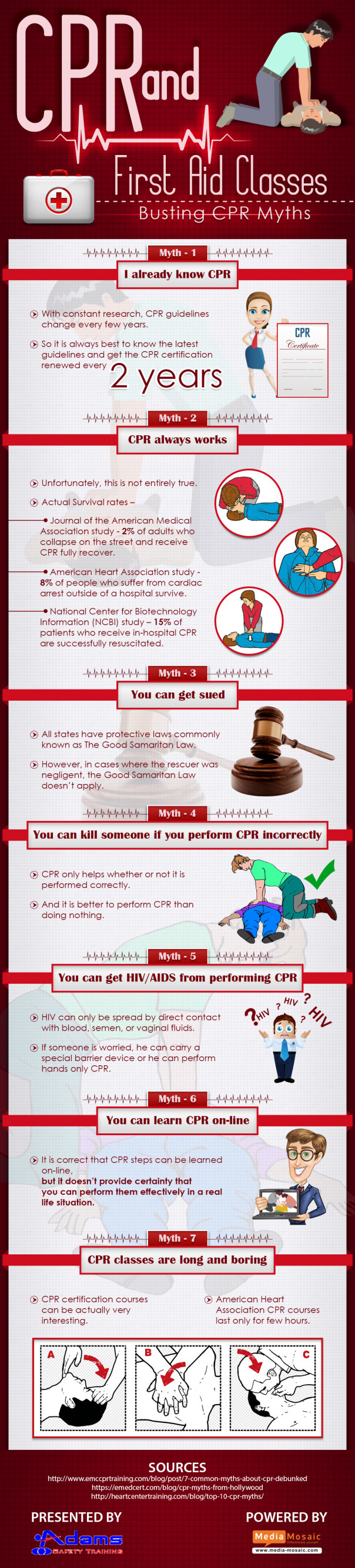
7 CPR Myths and their explanations – Infographic

CPR (Cardiopulmonary Resuscitation) is a life saving technique that can save the life of a person suffering a sudden heart attack. By maintaining blood flow to the brain and the heart, CPR can give some extra time to the patient and increase his chances of survival.

Despite being such an important technique, there are many myths and misconceptions about CPR. Some people wrongly believe that they can get dangerous diseases like HIV by performing CPR. This is entirely wrong. Performing CPR doesn’t put you at risk of getting diseases. Also, many people believe that CPR can easily be learnt online. While you can gain an understanding of CPR technique online, it doesn’t mean you’ll be able to apply it in reality when the situation demands.

For this reason, it is important to learn CPR technique from a trained medical professional. There are many professional CPR training service providers that can teach the right way to give CPR in an emergency situation.

7 CPR Myths and their explanations

Which CPR class should I attend?

Cardiopulmonary resuscitation (CPR) is a lifesaving technique that is performed with alternating chest compressions with mouth-to-mouth breathing. It is one of the most basic types of medical training provided to people. It can be very useful when it comes to providing immediate medical help to a person who’s suffered a sudden cardiac arrest. By reviving the heartbeat and breathing, CPR can provide the much-needed oxygen to the brain. This can save the life of a person.

There are two different levels of CPR training – CPR for medical professionals and CPR for non-medical professionals. CPR training provided to non-medical professionals and paramedics is different. Below are the three main categories under which CPR training class fall –

Adult CPR classes
These are the most basic type of CPR classes that are ideal for non-medical professionals. For adult CPR classes, you don’t need any medical know-how. They are of short duration and are usually completed in less than an hour. In adult CPR classes, people can learn how to perform CPR on adults and children above 8 years of age.

Infant CPR classes
Infant CPR classes are ideal for people who spend too much time among children. These include teachers, babysitters and other non-medical professionals. Knowing how to perform CPR on children can prove to be very useful when it comes to facing any eventuality. This training enables coaches to provide immediate medical help to infants and children below the age of 8 years.

CPR classes for medical professionals
These are advanced CPR classes for medical professionals. Be it nursing students or dental assistants, it is essential for every professional in a doctor’s office to possess an advanced CPR certification. These classes cover AED, ventilation devices and two-person CPR techniques.  These classes are also called Basic Life Support for Healthcare Providers. Most hospitals and clinics have AED and it’s important for workers to know how it is used.

CPR training classes are for everyone. However, some people require CPR training more than others. Flight attendants, fitness instructors, social workers, construction workers, pool and beach lifeguards, jail personnel, teachers and child care providers should learn how to perform CPR technique. Knowing how to perform CPR can help you save the life of an individual!

The basics of CPR

Cardiopulmonary resuscitation (CPR) is a lifesaving technique that is of immense use in various emergency situations including heart attack or near drowning. CPR keeps oxygenated blood flowing to the brain and other vital organs until the victim gets medical treatment to restore normal heart beat and rhythm.

To perform CPR, keep in mind the acronym of CAB-Circulation, Airway, and Breathing. Circulation involves restoring blood circulation with chest compressions. You must put the victim on his back on a firm surface. Place the heel of one of your hand over the center of the victim’s chest and place your other hand on top of the first hand. Keep your elbows straight and position your shoulders directly above your hands. Now push down and compress the chest at least 2 inches. Push hard and give about 100 compressions in a minute.

Airway is performed to clear the obstructed airway. Put your palm on the victim’s forehead and gently tilt his head back. Then using your other hand, you must gently lift the chin forward to open the airway.

Breathing is the third step of CPR. It may involve mouth-to-mouth breathing or mouth-to-nose breathing if the mouth is severely injured or it can’t be opened. For mouth-to-mouth breathing, pinch the nostrils shut and cover the victim’s mouth with yours, making a seal. Give two rescue breaths. Give the first rescue breath and watch if the chest rises. If it doesn’t, give the second rescue breath. Give chest compressions to restore blood circulation. If the victim still doesn’t move, use an AED or Automatic External Defibrillator. You must continue with CPR until the victim shows signs of movement or emergency medical professional comes over.

To learn to do CPR correctly, you may complete CPR certification in Redwood City. Look out for reliable and renowned providers of CPR and first aid training in Redwood City.

How to perform CPR on adults? – Infographic

Cardiac arrest is one of the leading causes of death in the world. A significant number of cardiac arrests occur in people with no risk factors. During a cardiac arrest, the breathing and heartbeat of the person stops. Providing immediate help can go a long way when it comes to saving the life of a person. With Cardiopulmonary Resuscitation (CPR), the chances of survival of the person can be significantly increased.

CPR is basically a life saving technique that can restart the breathing of a person who’s suffered the cardiac arrest. It is performed with alternating chest compressions with mouth-to-mouth breathing. It’s a simple technique that can be easily learned. Adam Safety Training is a certified training institute providing American Heart Association BLS for Health care Providers.

In the below Infographic, we’ve tried to explain the correct method of giving CPR to an adult. The aim of this Infographic is to throw some light on CPR method.

How to perform CPR on adults